Table of Contents
- What is Accounting?
- Objectives of Accounting
- Why is Accounting Important?
- Types of Accounting
- Basic Accounting Concepts
- The Golden Rules of Accounting
- Double Entry System
- The Accounting Cycle
- Journal Entries
- Ledger
- Trial Balance
- Financial Statements
- Accounting Software
- Common Mistakes to Avoid
- Frequently Asked Questions
- Conclusion
What is Accounting?
Accounting is the systematic process of recording, classifying, summarizing, analyzing, and reporting financial transactions of a business. It helps owners, investors, banks, government authorities, and other stakeholders understand the financial health of an organization.
Every business—whether a small shop, startup, freelancer, partnership, or multinational company—relies on accounting to manage money and make informed decisions.
Objectives of Accounting
The primary objectives of accounting are to:
- Maintain accurate financial records.
- Determine profit or loss.
- Understand the financial position of the business.
- Support management decision-making.
- Ensure compliance with tax and legal requirements.
- Assist in budgeting and forecasting.
- Provide reliable information to investors and lenders.
Why is Accounting Important?
Accounting plays a vital role in every organization.
1. Tracks Income and Expenses
Every financial transaction is recorded to monitor cash flow and profitability.
2. Measures Business Performance
Accounting helps compare current performance with previous years to identify growth opportunities.
3. Tax Compliance
Proper accounting makes GST, Income Tax, VAT, and Corporate Tax filings easier and more accurate.
4. Better Decision-Making
Financial reports provide valuable insights for budgeting, investment, pricing, and cost control.
5. Builds Credibility
Accurate books increase confidence among investors, banks, suppliers, and customers.
Types of Accounting
Different branches of accounting serve different purposes:
| Type | Purpose |
|---|---|
| Financial Accounting | Preparation of financial statements |
| Management Accounting | Internal decision-making and planning |
| Cost Accounting | Cost control and pricing |
| Tax Accounting | Compliance with tax laws |
| Auditing | Verification of financial records |
| Government Accounting | Public sector financial management |
| Forensic Accounting | Investigation of fraud and disputes |
Basic Accounting Concepts
Understanding these concepts is essential for every beginner.
Business Entity Concept
The business is treated as separate from its owner.
Going Concern Concept
Financial statements are prepared assuming the business will continue operating.
Money Measurement Concept
Only transactions measurable in monetary terms are recorded.
Accrual Concept
Income and expenses are recognized when they are earned or incurred, not necessarily when cash is received or paid.
Consistency Concept
Accounting methods should be applied consistently to enable meaningful comparisons.
The Golden Rules of Accounting
Traditional accounting is based on three golden rules:
| Account Type | Rule |
|---|---|
| Personal Account | Debit the Receiver, Credit the Giver |
| Real Account | Debit What Comes In, Credit What Goes Out |
| Nominal Account | Debit All Expenses and Losses, Credit All Incomes and Gains |
These rules help determine how transactions are recorded in journal entries.
Double Entry System
Every transaction affects at least two accounts.
For every:
- Debit, there is an equal Credit.
Example
A business purchases office furniture worth ₹50,000 in cash.
| Account | Debit | Credit |
|---|---|---|
| Furniture A/c | ₹50,000 | - |
| Cash A/c | - | ₹50,000 |
This ensures that the accounting equation remains balanced.
The Accounting Cycle
The accounting cycle is the step-by-step process followed during an accounting period:
- Identify financial transactions.
- Record them in the journal.
- Post entries to the ledger.
- Prepare the trial balance.
- Pass adjusting entries (if required).
- Prepare financial statements.
- Close temporary accounts.
- Begin the next accounting period.
Journal Entries
A journal is the book of original entry where transactions are first recorded chronologically.
Example:
Paid office rent of ₹15,000 by bank.
| Particulars | Debit | Credit |
|---|---|---|
| Rent Expense A/c | ₹15,000 | - |
| Bank A/c | - | ₹15,000 |
Ledger
The ledger groups all transactions account-wise, making it easy to determine the balance of each account.
For example, all cash transactions are posted to the Cash Account, while all sales transactions are posted to the Sales Account.
Trial Balance
A trial balance is prepared to verify that the total debits equal the total credits.
If they do not match, it indicates that errors may exist in the accounting records.
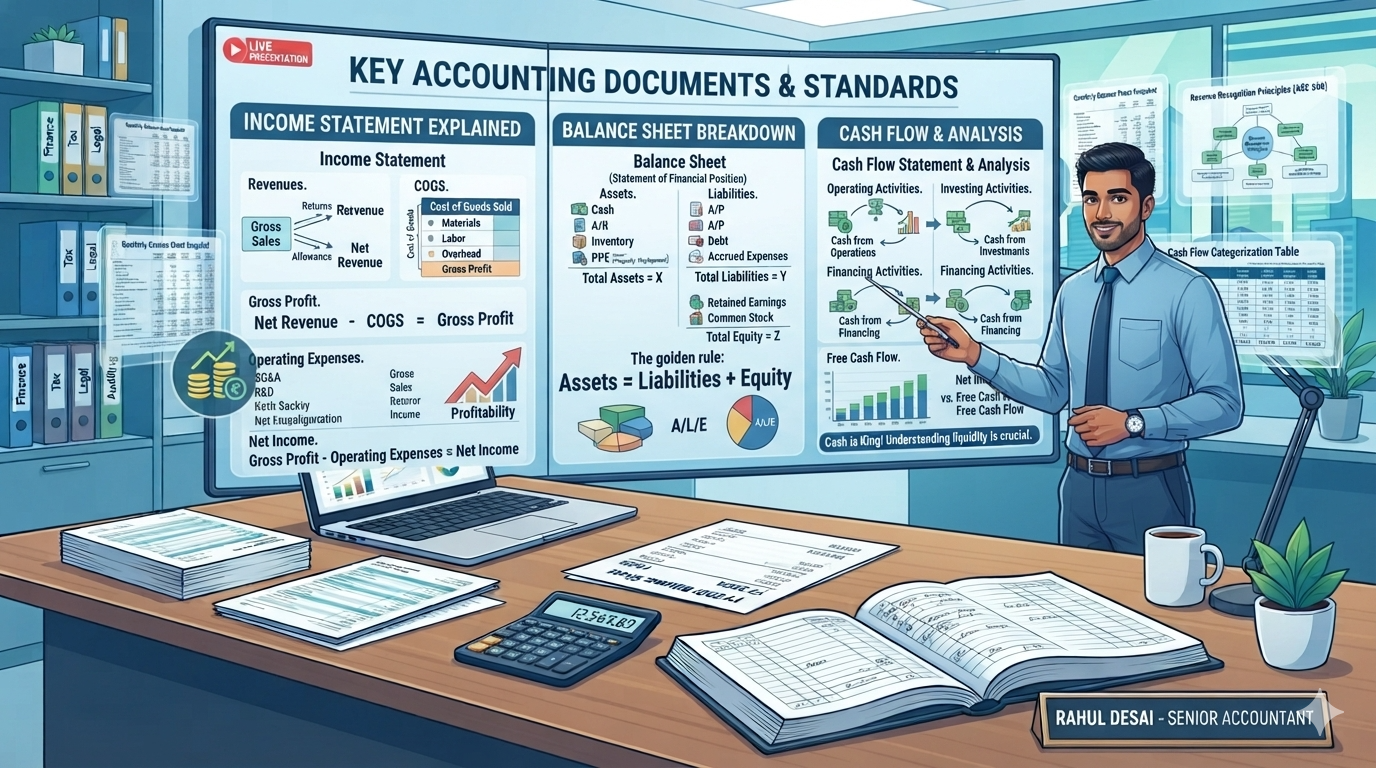
Financial Statements
The main financial statements prepared at the end of an accounting period are:
Profit & Loss Statement
Shows the business's income, expenses, and net profit or loss.
Balance Sheet
Displays assets, liabilities, and owner's equity as of a specific date.
Cash Flow Statement
Shows cash inflows and outflows from operating, investing, and financing activities.
Accounting Software
Popular accounting software includes:
- Tally Prime
- QuickBooks
- Zoho Books
- Busy Accounting Software
- Marg ERP
- Xero
- SAP
- Oracle NetSuite
Choosing the right software depends on the size and needs of your business.
Common Mistakes to Avoid
- Mixing personal and business expenses.
- Recording transactions late.
- Ignoring bank reconciliations.
- Not maintaining supporting documents.
- Incorrect classification of expenses.
- Failing to back up accounting data.
- Not reviewing financial reports regularly.
Frequently Asked Questions
What is accounting in simple words?
Accounting is the process of recording and reporting financial transactions to understand the financial position of a business.
Is bookkeeping the same as accounting?
No. Bookkeeping focuses on recording transactions, while accounting includes analysis, reporting, and interpretation.
Why is the double entry system important?
It ensures every transaction is recorded accurately and keeps the accounting equation balanced.
Which accounting software is best?
The best software depends on business size, budget, and reporting requirements. Tally Prime, QuickBooks, and Zoho Books are popular choices for small and medium businesses.
Conclusion
Accounting is the backbone of every successful business. By understanding the basics—such as accounting concepts, journal entries, ledgers, trial balance, and financial statements—you can make informed financial decisions, maintain compliance, and evaluate business performance effectively.
Whether you are a student, entrepreneur, freelancer, or finance professional, mastering accounting fundamentals is the first step toward building strong financial knowledge.